HVAC Website Design Built for No-Cool and No-Heat Calls
HVAC website design means building a heating and air company's site around three kinds of calls: no-cool and no-heat repairs that need a phone number right now, system replacements where the homeowner compares quotes, and maintenance plans that keep customers coming back between breakdowns. Good web design for HVAC puts tap-to-call on every screen, gives repair, replacement and maintenance their own pages, lists the towns you serve, shows your license and reviews, and matches your Google Business Profile. DG Agency builds HVAC websites as a one-time project starting at $5,000.
By Daniel Gonzalez, founder of DG Agency. Updated . Every number names its source and date range.
What an HVAC website needs
- A call button that stays on screen on a phone, all day and all season
- No-cool and no-heat repair at the top of the home page
- Separate pages for AC repair, replacement, heating, heat pumps and maintenance plans
- One page per town you serve, each one about that town
- Your license number, checked against the state record first
- Your own job photos and reviews, never stock
- A maintenance plan signup that works on a phone
- Name, phone and service area that match your Google Business Profile
- A short form or text option for the call you can't pick up
What We Can Show You, and What We Can't
We don't have an HVAC client right now. We've done HVAC work in the past, but there is no HVAC site in our portfolio today, and we won't put another trade's numbers on this page as if they were HVAC results. What we can show you is the build. An HVAC site uses the same structure as the plumbing and restoration sites we have live, and the numbers below are from those sites, labeled with the trade they came from.
Plumbing and roofing numbers, not HVAC. TMC's clicks rose after the rebuild and the SEO we ran on it together, and roofing search is seasonal, so we credit both, not the website alone.
- bizebeeplumbing.com
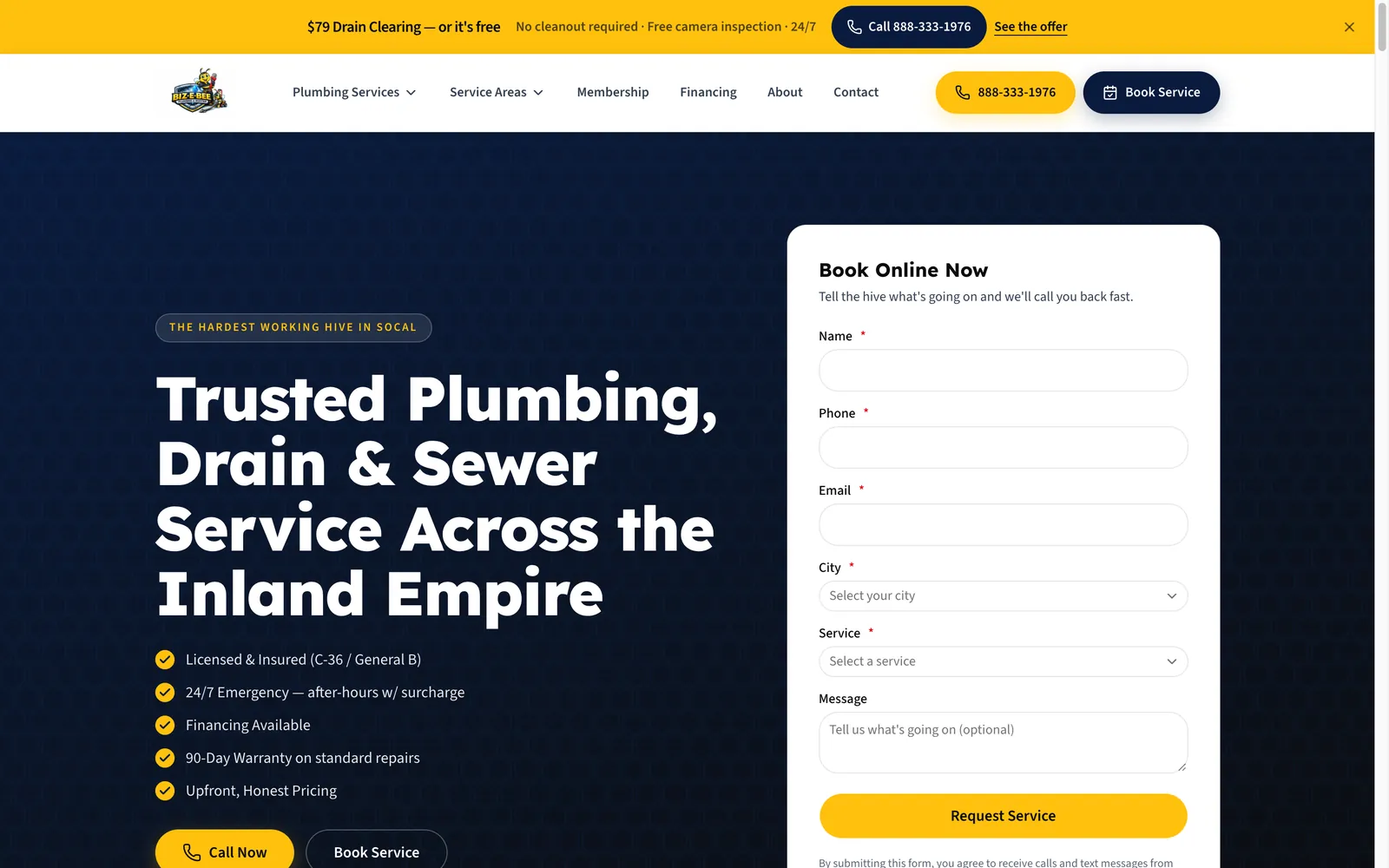

Plumbing, drain and sewer
Biz-E-Bee Plumbing & Rooter
- Book-online form right in the hero, next to the headline
- Call and book buttons that stay on screen as you scroll a phone
- Service and city pages built to show up in local search
- tnlservices.com
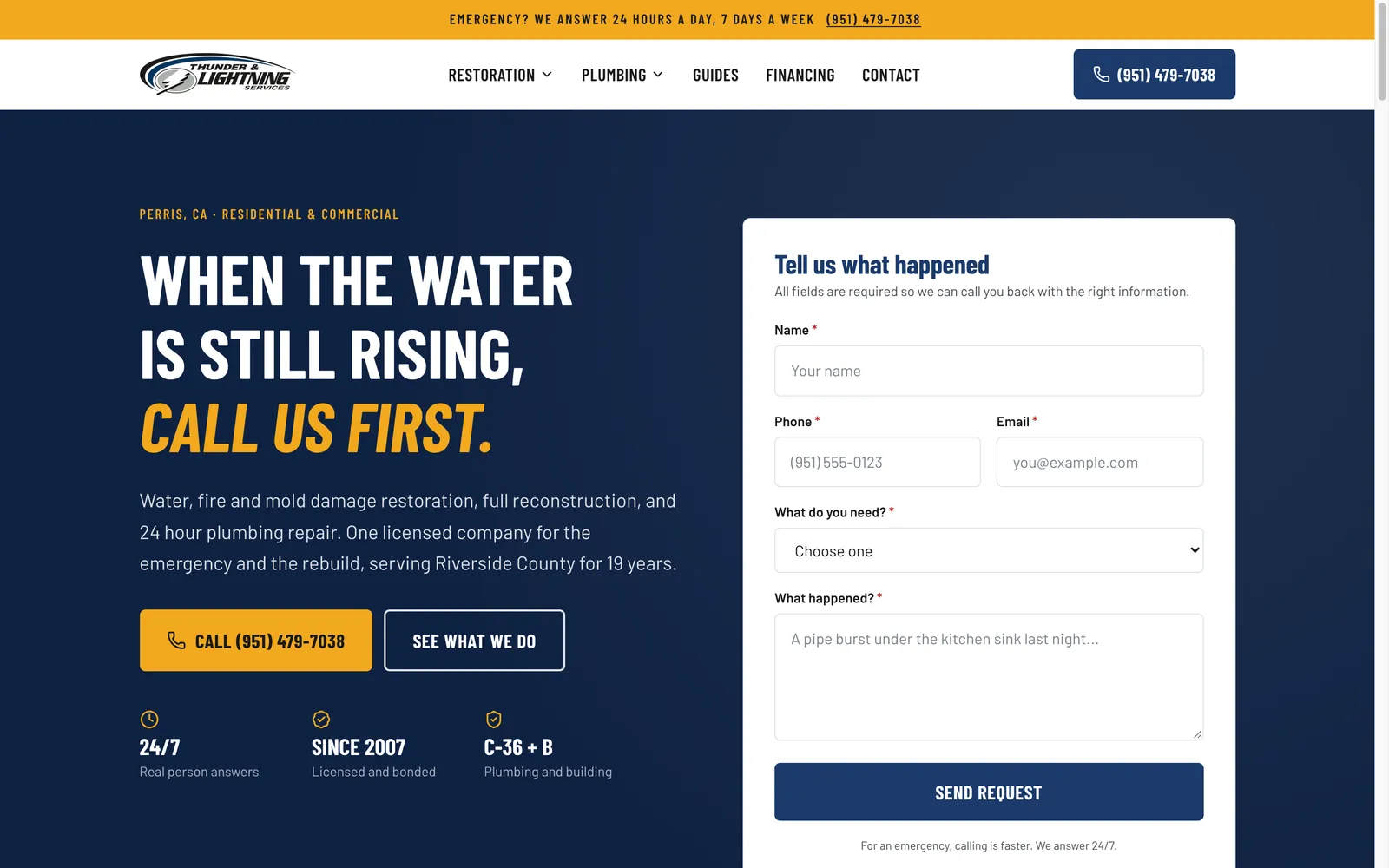
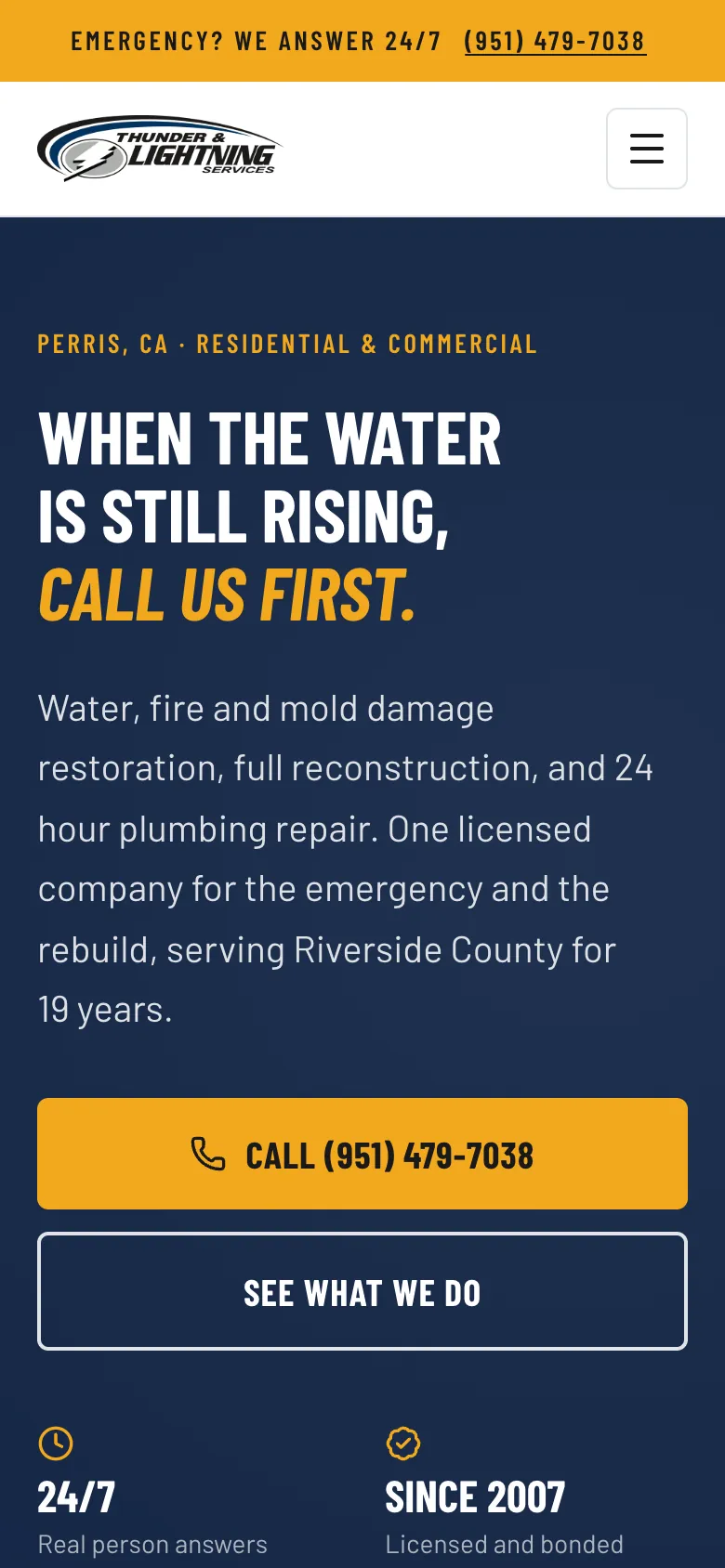
Water, fire and mold restoration plus plumbing
Thunder & Lightning Services
- Emergency-first layout with the phone number in the top bar
- A "tell us what happened" intake form, so the first call starts with context
- Restoration and plumbing under one license, one site
Three Kinds of HVAC Calls, Three Kinds of Pages
A homeowner whose AC died on a hot afternoon and a homeowner pricing a new system next spring are not reading the same page. The first one wants a number to call and some sign you can come today. The second wants to know which brands you install, what happens on install day, whether you offer financing and what other homeowners said about their replacement. Put both on one page and you serve neither.
So the site gets split by call type. Repair pages for cooling and heating lead with the phone number. Replacement pages explain the process and carry the reviews from installs. A maintenance plan page explains what the plan covers and lets a customer sign up from a phone without a five-field form. That page is how an HVAC company stays in touch between breakdowns.
Seasonal messaging should change when the weather does. When the first heat wave hits, the AC repair page is the one doing the work, and in the first cold snap it is the furnace page. A site with one generic services page can't do that.
The pages we usually build for an HVAC company look like this:
- AC repair
- AC replacement and new system installs
- Heating and furnace repair
- Heat pump repair and installs
- Ductwork
- Maintenance plans
After Hours and Weekends Are Where Calls Slip
A no-cool call doesn't wait for Monday. In our own Local Services Ads data, weekend calls were answered 46.3% of the time, against 78.6% on weekdays from 8am to 5pm (121 vs 1,158 calls, November 2025 to October 16, 2026). Weekday calls before 8am or after 5pm were 6.8% of leads. That data covers several trades, but the pattern is the one every HVAC owner knows from July.
A website can't answer the phone for you. It can give the homeowner a second way in: a short form or a text option that reaches whoever is on call, so the job doesn't go to the next company on the list. Thunder & Lightning Services, a restoration and plumbing company we built for, uses an emergency-first layout with the phone number in the top bar and a short intake form that asks what happened, so the first call back starts with context.
If missed calls are the bigger problem, the fix is answering, not the site. We cover that on our speed to lead page and the HVAC marketing agency page.
A Page for Each Town You Serve
An HVAC company drives to the customer, so it needs a page for each town worth working. The trap is the same page with the town name swapped. It reads as thin to Google and to the homeowner who lives there. Each of the city pages on Biz-E-Bee's plumbing site was built from primary-source research about that town, and we build HVAC town pages the same way.
Most HVAC companies are service-area businesses. Google's guidelines say a business that serves customers at their location should hide its street address (Google Business Profile guidelines). Your website has to match your profile, so it shows the area you serve instead of a street address, and the business name on the site is the same name your customers and your trucks use.
License, Brands and Reviews
Homeowners want to know you are licensed before they let a tech into the house, and Google checks too. Local Services Ads screening includes a license check (Google's LSA screening page). In California the heating and air classification is C-20 (CSLB license classifications). Getting an HVAC company through Google's screening is its own process, and we cover it on our HVAC marketing agency page.
Only publish what the state record shows. On every site we build, we look the license up first and publish exactly what the record says. On Biz-E-Bee's plumbing site that meant taking off a license class the record didn't show.
List the equipment brands you actually install and any dealer status you actually hold. Use your own install photos and your own reviews. A clean install in a real attic beats a stock photo of a smiling tech every time.
A Site Google Can't Index Can't Ring
This one is a roofing story, but the failure looks the same on any trade. TMC Roofing's old site ran on Lovable. Our April 29, 2026 audit found 156 pages submitted to Google in 5 sitemaps and 0 of them indexed. A good-looking site that Google can't read does nothing.
We rebuilt it in Next.js in May 2026 and kept all 156 live URLs at the same address, so no redirects were needed. Google search clicks went from 402 in February to April to 870 in August to October 2026, and the keywords on Google's first page went from 11 to 33 between April and October by SE Ranking's count. We ran SEO on the new site too and roofing search is seasonal, so the credit goes to the rebuild and the SEO together.
It didn't all go right. On July 30, after the rebuild, 21 or more city pages were still out of Google's index on a stale noindex verdict. Fixing indexing is ongoing work, not a launch-day checkbox. The full story is in the TMC Roofing case study.
Fast on a Phone, Readable by Google
Google measures page experience with Core Web Vitals. A page passes when its main content shows in 2.5 seconds or less, it reacts to a tap within 200 milliseconds and the layout moves no more than 0.1, measured at the 75th percentile of real visits (web.dev). We build in Next.js, the same stack as every site in our portfolio, with no page builder and no pile of plugins.
Every page gets schema, the structured data that tells Google your business, services and service area. Pages also answer the questions homeowners ask in plain words, which is what ChatGPT and Google's AI answers look for when someone asks who to call. Nobody can force an AI tool to name you.
Every Lead Saved, Every Call Tracked
A form that emails one inbox gets lost in the middle of a heat wave. On the sites we build, the quote form lands in your email within seconds and, where we set it up, in a database with an instant alert. Biz-E-Bee's form was saving to a database by July 15, 2026, five days into the build.
Call tracking tells you which calls came from the website and which came from your Google profile or ads. A tracking number goes on the site and on each ad source, and your real number stays on your Google profile and directories. See call tracking and CRM integrations for how that plugs into ServiceTitan or Housecall Pro.
After launch, the ongoing work is search. That is SEO for HVAC companies, and it is separate from the build.
What HVAC Web Design Costs
We don't publish a price range we don't charge. An HVAC site costs the same as any other trade site we build, because the work is the same.
- Starts at $5,000 as a one-time project, separate from any monthly marketing retainer. You get a fixed quote before we start.
- The price moves with the number of job-type and town pages you need, and with whether we are moving an old site without losing the rankings it already has.
- Hosting runs on Vercel in your own account, about $20 a month on Vercel's Pro plan, billed to you by Vercel and not marked up by us.
- You own the domain, the site and the code. Before launch the hosting project and the code repository move into accounts in your name.
Website design is a separate service from our monthly marketing retainer. See how our web design works or full pricing.
How Long HVAC Web Design Takes
Most builds take 4 to 8 weeks from kickoff to launch. A rebuild of an existing site follows the order we used on TMC Roofing in May 2026:
Week 1
Audit the old site: what Google has indexed, which pages get clicks, which URLs have to stay.
Weeks 1 to 2
Page plan: one page per call type and per town, mapped to what homeowners search.
Weeks 2 to 5
Build and write. Forms wired first. On TMC's rebuild the forms were saving to the database on May 5.
Weeks 5 to 7
Titles, schema and content. TMC had new titles on May 6, 13 blog posts by May 12 and sitewide schema on May 14.
Launch
Old URLs kept or mapped to the new ones so existing rankings carry over, then a check of what Google indexes.
HVAC Website Design FAQ
How much does HVAC website design cost?
+
Our HVAC websites start at $5,000 as a one-time project, separate from any monthly marketing retainer. The price depends on how many job-type and town pages you need and whether we are moving an old site without losing its rankings. You get a fixed quote before we start. Hosting runs in your own Vercel account at about $20 a month, billed by Vercel.
Do you have HVAC websites I can look at?
+
Not right now. We have done HVAC work in the past, but there is no HVAC site in our portfolio today and no current HVAC client. The sites you can open are plumbing, roofing, restoration and gutter companies. An HVAC site is built the same way, with the pages changed for repair, replacement and maintenance plans.
What should an HVAC company website include?
+
A tap-to-call button on every screen, no-cool and no-heat repair at the top of the home page, separate pages for AC repair, replacement, heating, heat pumps and maintenance plans, a page for each town you serve, your license, your own install photos and reviews, and a short form or text option for calls you can't pick up. Your name, phone and service area should match your Google Business Profile.
How long does web design for an HVAC company take?
+
Most builds take 4 to 8 weeks from kickoff to launch. A rebuild starts with an audit of what Google already indexes, so pages that rank keep their address. The forms get wired first, then titles, schema and content.
Should an HVAC website have online booking?
+
It should have a short booking or quote form, yes. Most homeowners with a dead AC will call, but some would rather send a form at night or when they can't talk. Keep it to a few fields, make it work on a phone, and send it straight to whoever books jobs so it gets a call back fast.
Who owns the HVAC website when you build it?
+
You do. The domain is in your name, the site and the code are yours, and the hosting and code repository move into accounts in your name before launch. If you ever stop working with us, the site keeps running.
Will a new HVAC website get me to the top of Google?
+
Nobody honest can promise a ranking. What we can promise is a site built the way Google expects: a page for each call type and town, schema, your Google Business Profile tied in and fast pages on a phone. Rankings also depend on your reviews, your Maps listing and your competition.

Want an HVAC site that rings in July?
Book a 45-minute call with Daniel. Bring your current site and he'll show you what's missing and what a rebuild would cost.
Not ready to talk? Or see the sites we've built